Signs of Poor Indoor Air Quality: A Fort Worth Homeowner's Guide to Whole-Home Purification
Learn how to identify signs of poor indoor air quality and explore whole-home purification solutions for healthier living.

Did you know that the air inside your Fort Worth home could be significantly more polluted than the air outside? In our effort to build energy-efficient, tightly sealed houses, we've accidentally created environments that trap allergens, pet dander, and moisture right where we breathe. It's a common struggle for local families who find themselves constantly battling signs of poor indoor air quality without even realizing the source of their discomfort.
You likely agree that your home should be a sanctuary, yet it's exhausting to deal with persistent allergy symptoms, stuffy rooms, or dust that reappears minutes after you clean. We understand that protecting your family's health is your top priority, and we believe you shouldn't have to guess about the safety of your environment. This guide will help you identify the hidden warning signs of unhealthy air and discover how modern whole-home purification systems can restore your home's comfort and breathability. We'll walk through specific IAQ red flags, compare the most effective purification technologies available today, and show you how to achieve the peace of mind that comes with a truly clean, professional grade living environment.
Key Takeaways
Learn to recognize the physical signs of poor indoor air quality, from persistent morning congestion to excessive dust, that indicate your home’s air needs professional attention.
Understand why the Fort Worth climate and modern "tight" home construction often trap pollutants and humidity inside your living spaces.
Compare the coverage and maintenance of whole-home purification systems against portable units to find the most efficient solution for your entire household.
Explore how technologies like UV germicidal lights and HEPA filtration work to neutralize biological threats and microscopic particulates.
Discover how a professional indoor air quality assessment provides a clear path toward restoring comfort and ensuring your family breathes easier every day.
Table of Contents
The Texas HVAC Trap: Why DFW Homes Struggle with Air Quality
Whole-Home Air Purification vs. Portable Units: A Comparison
Physical and Environmental Signs of Poor Indoor Air Quality
Your home should be your safest place, but sometimes it's the source of your discomfort. Many homeowners are surprised to learn that "Sick Building Syndrome" isn't just for office workers; it can happen in any residential setting where Indoor air quality (IAQ) is compromised. When pollutants circulate through your HVAC system without proper filtration, they create a cycle of irritation. These signs of poor indoor air quality often start subtly, but they quickly impact your family's domestic harmony and overall peace of mind.
Health Red Flags: When Your Home Makes You Sneeze
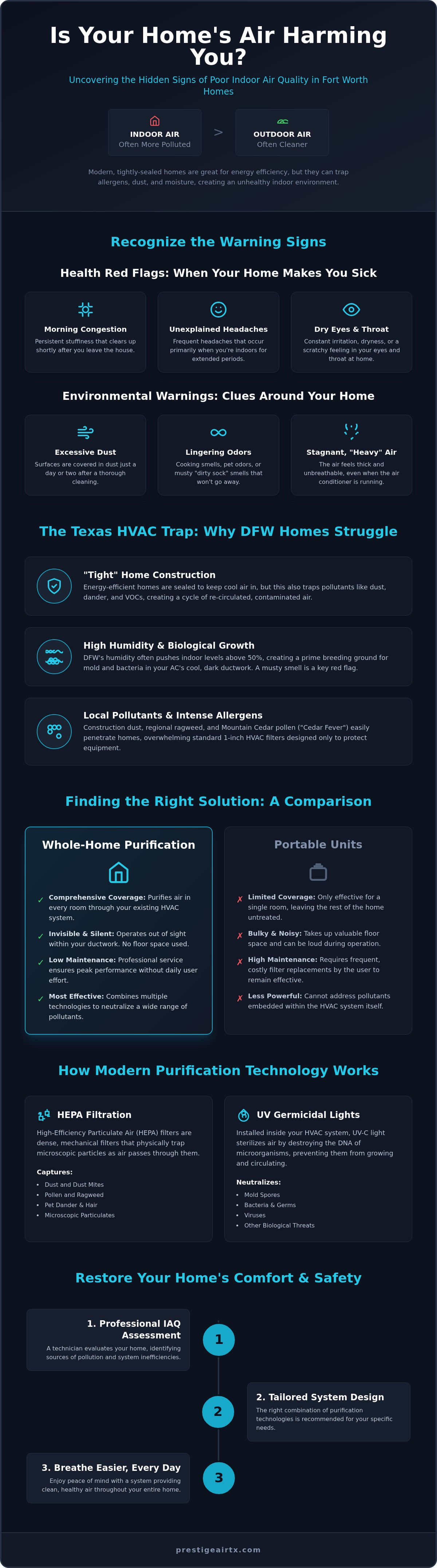
Do you notice that your sneezing stops the moment you step out for the mail? Identifying "indoor-only" allergy symptoms is one of the most reliable ways to pinpoint a problem. If your morning congestion or dry eyes vanish once you're at the office, your home environment is likely the culprit. Children and the elderly often act as the "canaries in the coal mine" for these issues because their respiratory systems are more sensitive to airborne particulates. Common health triggers include:
Frequent, unexplained headaches that occur primarily while indoors
Persistent dry eyes or throat irritation despite using a humidifier
Chronic morning congestion that clears up shortly after leaving the house
Poor air quality also disrupts sleep. High levels of dust and microscopic allergens can lead to restless nights and even increased snoring. For families already dealing with asthma or seasonal allergies, these pollutants turn a manageable condition into a constant struggle for breathability.
Environmental Warnings: What Your Furniture is Telling You
Your home often provides visible clues before your health fully declines. Have you performed the "dust test" lately? If your coffee table is covered in a gray film just 24 hours after a deep clean, your filtration system is failing to capture particulates. This excessive buildup is a major indicator of system inefficiency. You might also notice lingering "dirty sock" odors or cooking smells that refuse to dissipate. These aren't just nuisances; they're indicators that your air is stagnant. When the air feels heavy or "unbreathable" despite the AC running, it's a clear signal that your home's health needs a professional diagnostic. Recognizing these signs of poor indoor air quality is the first step toward restoring the safe, breathable environment your family deserves.
The Texas HVAC Trap: Why DFW Homes Struggle with Air Quality
Living in North Texas presents a unique challenge for home comfort and health. To combat our relentless summer heat, modern homes in Keller and Southlake are built to be incredibly energy-efficient and airtight. While this "tight" construction is excellent for your utility bills, it creates a sealed environment where pollutants have nowhere to go. Without proper ventilation, your family is essentially breathing the same recycled air, trapped alongside whatever microscopic hitchhikers have made their way inside.
Humidity and Biological Growth in Fort Worth
Humidity is a constant factor in the DFW climate, and it's often the primary driver of signs of poor indoor air quality. When indoor relative humidity levels climb above the 50% threshold, your home's ductwork can quickly become a breeding ground for biological growth. The condensation that naturally occurs during your AC's cooling cycle provides the perfect moisture source for mold spores to thrive. If you notice a persistent "musty" smell when your system kicks on, it's often a signal of active growth within your climate control system that needs professional attention.
Local Pollutants: From Construction Dust to Pollen
The ongoing construction boom across our local communities introduces fine silica and drywall dust into the air, which easily bypasses standard window seals and door gaps. When you combine this with our intense regional ragweed and pollen cycles, your home's interior can become more polluted than the outdoors. Cedar Fever is an intense allergic reaction to the high concentrations of Mountain Cedar pollen that infiltrate indoor spaces during North Texas winters, often overwhelming standard filtration systems and causing significant domestic discomfort.
Many homeowners rely on standard 1-inch pleated filters, but these are designed primarily to protect the HVAC mechanical components from large debris, not to purify the air you breathe. In a high-pollution environment like North Texas, these thin filters are often insufficient. According to the CPSC guide to indoor air quality, identifying these sources of pollution is the first step toward creating a safer living environment. Is your AC system actually cleaning your air, or is it just circulating the same dust every hour? If you're concerned about the "Texas HVAC Trap" in your own home, a professional indoor air quality assessment can provide the clarity you need to protect your family's health. Addressing these signs of poor indoor air quality requires a strategy that goes beyond basic hardware and focuses on long-term restoration.
Whole-Home Air Purification vs. Portable Units: A Comparison
When you first notice signs of poor indoor air quality, your immediate instinct might be to pick up a few portable air purifiers from a local big-box store. While these devices provide a sense of immediate action, they often act as a temporary fix rather than a permanent solution for a large North Texas home. Choosing between a localized approach and an integrated system requires looking at the long-term health and comfort of your entire household.
Portable Purifiers: The Band-Aid Solution
Portable units make sense for small apartments or specific, temporary situations like a guest room. However, they rely on a metric called the Clean Air Delivery Rate (CADR), which measures how much filtered air a unit delivers. In the spacious, open-concept floorplans common in Keller and Southlake, a single portable unit is often overwhelmed. It only cleans the air in its immediate vicinity, leaving the rest of the house vulnerable. Most importantly, portable units can't address the root cause of many signs of poor indoor air quality, such as the dust, dander, and biological growth accumulating deep within your ductwork. You're essentially cleaning the air in one corner while the HVAC system continues to blow pollutants through the rest of the house.
Whole-Home Systems: The Integrated Advantage
A whole-home system offers a sophisticated, integrated advantage by living directly within your existing HVAC cabinet. These systems work silently to treat every cubic foot of air before it ever reaches your vents. This ensures that the air is purified at the source, protecting every square foot of your living space simultaneously. Because these systems are built into your climate control, they don't clutter your rooms with bulky plastic towers or trailing power cords. This integrated approach aligns with the recommendations found in A Guide to Indoor Air Quality, which emphasizes the importance of comprehensive ventilation and source control.
When you consider the total cost of ownership over a five-year period, the value of a whole-home system becomes clear. Portable units require frequent filter replacements that can cost hundreds of dollars annually per unit. If you need four or five units to cover your home, those costs skyrocket alongside your electricity bill. A whole-home system is more efficient and can be seamlessly integrated into your professional HVAC maintenance plan. This ensures your purification technology stays in peak condition without the hassle of managing multiple small machines, providing the domestic harmony and peace of mind your family deserves.
Choosing the Right Technology for Your Home's Air
Once you've identified the signs of poor indoor air quality in your living space, the next step is selecting a technology that matches your specific household needs. Not every home requires the same level of intervention. A house with three pets and a high-traffic kitchen requires different tools than a new construction home struggling with lingering construction dust. Understanding how these systems work allows you to make a disciplined, informed decision for your family's long-term safety and comfort.
Filtering the Invisible: HEPA and Media Filters
Many homeowners confuse high MERV-rated filters with true HEPA performance. While MERV 11 to 16 media filters are excellent for capturing pollen and dander, true HEPA filtration remains the gold standard. It removes 99.97% of particles down to 0.3 microns. However, you can't simply slide a high-efficiency filter into a standard slot. These filters are dense; they require professional HVAC pressure testing to ensure they won't "choke" your AC blower motor. If the motor has to work too hard to pull air through a thick filter, it leads to expensive repairs and reduced efficiency. We focus on finding the perfect balance between high-level filtration and the mechanical health of your system.
Active Purification: UV-C and Ionization
While filters wait for pollutants to come to them, active purification goes on the offensive. UV-C germicidal lights provide targeted protection for your evaporator coils, neutralizing the biological growth that thrives in dark, damp spaces. If you've noticed the "musty" odors mentioned earlier, this is often the specific solution you need. Bipolar ionization takes this a step further by releasing ions that cause microscopic dust, smoke, and pet dander particles to "clump" together. This molecular-level process makes the particles large enough for your filters to actually catch them. For Texas families, it's essential to select systems with ozone-free certification to ensure your purified air remains safe and non-irritating for everyone in the house.
Activated carbon is the final piece of the puzzle, acting like a chemical sponge to eliminate VOCs and odors from cleaning products or new furniture. To discover which combination of these technologies will best resolve the signs of poor indoor air quality in your specific floorplan, schedule a professional indoor air quality assessment with our expert team today. We'll provide a clear, principled diagnostic that prioritizes your home's breathability and your family's peace of mind.
Restoring Home Comfort with a Professional IAQ Assessment
Identifying the signs of poor indoor air quality is a vital first step, but restoring your home's health requires a precise, professional diagnostic. A professional air quality audit from Prestige Air isn't a surface-level inspection. We treat your home as a complete system, analyzing your layout, occupancy levels, and the specific pollutants impacting your family. This methodical approach ensures that the solution we design is customized for your unique environment, rather than a generic, one-size-fits-all hardware installation.
During a professional assessment, our technicians evaluate your ductwork integrity, humidity levels, and particulate counts. This thoroughness allows us to recommend a targeted combination of the technologies discussed earlier, such as UV lights for biological growth or HEPA filtration for allergens. Professional installation is critical because it protects your system's warranty and ensures peak performance. When purification systems are integrated correctly, they don't just clean the air; they also improve the efficiency and lifespan of your HVAC system by keeping evaporator coils and blower motors free from restrictive debris.
The Prestige Air Difference: Disciplined, Residential Expertise
As a veteran-owned and family-operated business, we bring a disciplined mentality to every home we enter. We focus exclusively on residential service, which means our expertise isn't diluted by commercial distractions. Our technicians are dedicated members of the local community, serving families in Keller, Southlake, and North Richland Hills with the same care they'd provide their own neighbors. We believe in transparency and honesty, which is why we only recommend the specific tools your home actually needs to achieve domestic harmony and safety.
Next Steps: Taking Control of Your Indoor Environment
You don't have to wait for the peak of North Texas allergy season to take action. Scheduling a baseline air quality test now allows you to stay ahead of cedar fever and ragweed cycles. While you wait for your professional assessment, you can take simple steps to mitigate signs of poor indoor air quality today. Ensure you're changing your basic filters every 30 days and keep your return vents clear of furniture or heavy dust. These small actions help, but for a permanent restoration of your home's breathability, it's time for a professional diagnostic.
Ready to ensure your home is a safe sanctuary for your children and pets? Schedule your professional Indoor Air Quality Assessment with Prestige Air today and experience the peace of mind that comes with expert, principled service.
Take Control of Your Home's Breathability Today
Your journey to a healthier home begins with awareness. By recognizing the subtle signs of poor indoor air quality, you've already taken the most important step toward protecting your family. Whether you're battling the unique humidity challenges of North Texas or the persistent pollen cycles of the DFW area, you now understand that a whole-home approach is the most effective path to restoration. A properly integrated purification system doesn't just treat symptoms; it addresses the root cause within your ductwork, ensuring every room remains a safe sanctuary.
As a veteran-owned and family-operated business, we take pride in serving our neighbors with integrity and precision. We specialize exclusively in DFW residential HVAC, positioning us as dedicated experts in local indoor air quality. You deserve a home environment where you can breathe deeply and sleep soundly. Don't let hidden pollutants dictate your comfort for another season. Book Your Residential IAQ Assessment with Prestige Air today to receive a professional diagnostic from our expert team. We're ready to help you restore domestic harmony and provide the peace of mind your family deserves.
Frequently Asked Questions
What are the first signs that my indoor air quality is declining?
The earliest indicators often include a rapid buildup of dust on flat surfaces shortly after cleaning and a persistent "stale" feeling in the air. You might also notice lingering cooking odors or pet smells that refuse to dissipate over time. These are common signs of poor indoor air quality that suggest your current filtration isn't keeping pace with your household's needs. Pay close attention to whether family members experience frequent sneezing or dry throats when waking up.
Can poor air quality cause headaches and fatigue?
Yes, poor air quality is a frequent cause of chronic headaches, dizziness, and daytime fatigue for many homeowners. When pollutants like Volatile Organic Compounds or high levels of carbon dioxide are trapped in a tightly sealed North Texas home, they can lead to "Sick Building Syndrome." If your physical symptoms improve when you leave the house for work or errands, it's a strong signal that your indoor environment is impacting your neurological health and energy levels.
Is a whole-home air purifier better than a portable one for Texas homes?
For most homes in Southlake or Keller, a whole-home system is superior because it treats the air at the source before it circulates through your vents. Portable units only clean the air in a single room and often struggle with the large, open floorplans found in our local communities. An integrated system provides a comprehensive solution that protects every square foot of your living space without the noise or clutter of multiple individual machines.
How often should I change my HVAC filters to improve air quality?
You should generally replace standard 1-inch pleated filters every 30 to 60 days, especially if you have pets or live near active construction in North Richland Hills. High-efficiency media filters may last up to six months or a year, but they still require regular inspection. Neglecting these changes allows signs of poor indoor air quality to worsen as your HVAC system struggles to pull air through a clogged, dirty, and restrictive barrier.
Do whole-home air purifiers remove mold and bacteria?
Yes, whole-home systems equipped with UV-C germicidal lights or bipolar ionization are specifically designed to neutralize biological threats. While a standard filter only traps particles, these active technologies kill mold spores and bacteria on the evaporator coil and within the air stream. This is particularly important for Texas families dealing with the high humidity levels that often lead to biological growth inside dark, damp ductwork during our long cooling seasons.
What is a professional indoor air quality assessment?
A professional indoor air quality assessment is a comprehensive diagnostic audit of your home’s environment. Our technicians use specialized equipment to measure particulate matter, humidity levels, and chemical pollutants. We also inspect your ductwork and HVAC system for hidden growth or leaks. This process provides a clear, data-driven roadmap for restoring your home’s health, ensuring we recommend only the specific purification tools your family actually needs for domestic harmony.
How much does it cost to install a whole-home air purification system?
The investment for a whole-home air purification system varies based on the specific technology selected and the size of your existing HVAC system. Factors such as the complexity of the installation and the current condition of your ductwork also play a role. We recommend a professional assessment to determine the most effective and efficient solution for your home. This ensures you receive a customized strategy that delivers long-term value and peace of mind.
Can my HVAC system be the cause of the dust in my house?
Your HVAC system can certainly be the primary source of dust if you have leaky ductwork or inadequate filtration. Leaks in the return ducts often pull in attic dust, insulation fibers, and outdoor pollutants, which are then distributed throughout your living spaces. If you see "dust ghosts" around your supply vents, it's a sign that your system is circulating debris rather than removing it. Professional sealing and advanced filtration can solve this common issue.