Signs Your AC Compressor Needs Professional Repair: Myths vs. Reality (2026)
Explore common myths vs. realities about AC compressor issues. Find out when repairs, not replacements, could save you money this summer.
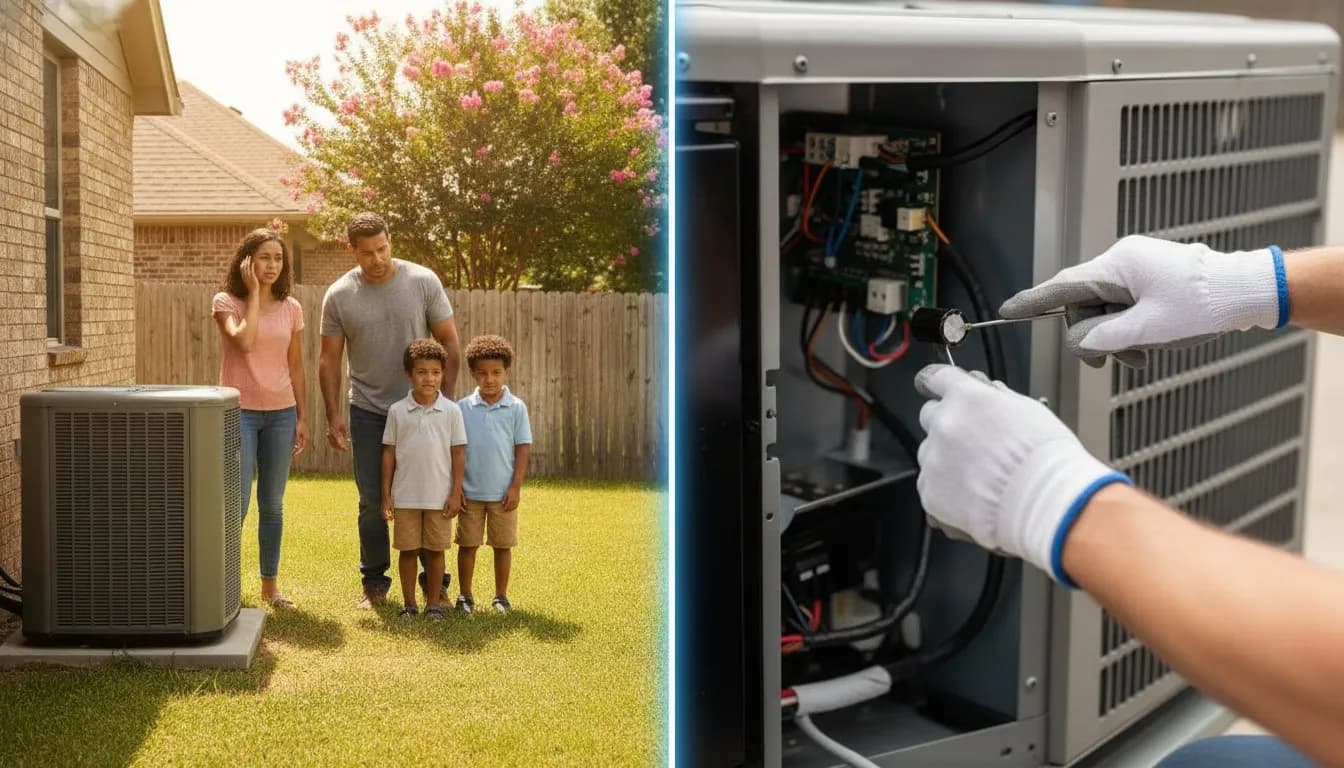
What if the most intimidating repair bill in the HVAC world was actually avoidable? When your cooling system grinds to a halt during a sweltering North Richland Hills July, the phrase "dead compressor" feels like a death sentence for your budget. You might assume that a loud buzzing or a warm vent means you're destined for a total system replacement. However, many homeowners are surprised to learn that what looks like a terminal failure often points toward a need for targeted AC compressor repair or even a simple electrical adjustment.
We understand the frustration of staring at a high energy bill while trying to decipher confusing technical jargon. It's natural to worry about being upsold on equipment you don't actually need. This guide cuts through the noise to show you the truth about mechanical failures versus minor component issues. We'll explore the real signs of a struggling unit, explain how the 2026 transition to A2L refrigerants like R-454B impacts your repair options, and provide a logical framework to help you decide when to fix your current system or finally invest in a new one.
Key Takeaways
Learn why a silent outdoor unit doesn't always mean a "blown" compressor and how small electrical parts like capacitors are often the real culprits.
Understand the "50% Rule" and why 10 to 12 years is the critical tipping point for deciding between a major repair and a full replacement.
Discover how a professional diagnosis for AC compressor repair can save you from unnecessary expenses by identifying simple fixes that mimic catastrophic failures.
Recognize the serious safety risks of DIY attempts, including high-voltage electrical hazards and federal EPA requirements for handling modern refrigerants.
Stay informed about the 2026 refrigerant transition and how new standards for A2L refrigerants influence the long-term value of your home cooling system.
Table of Contents
Is Your AC Compressor Actually Dead? Common Myths vs. Reality
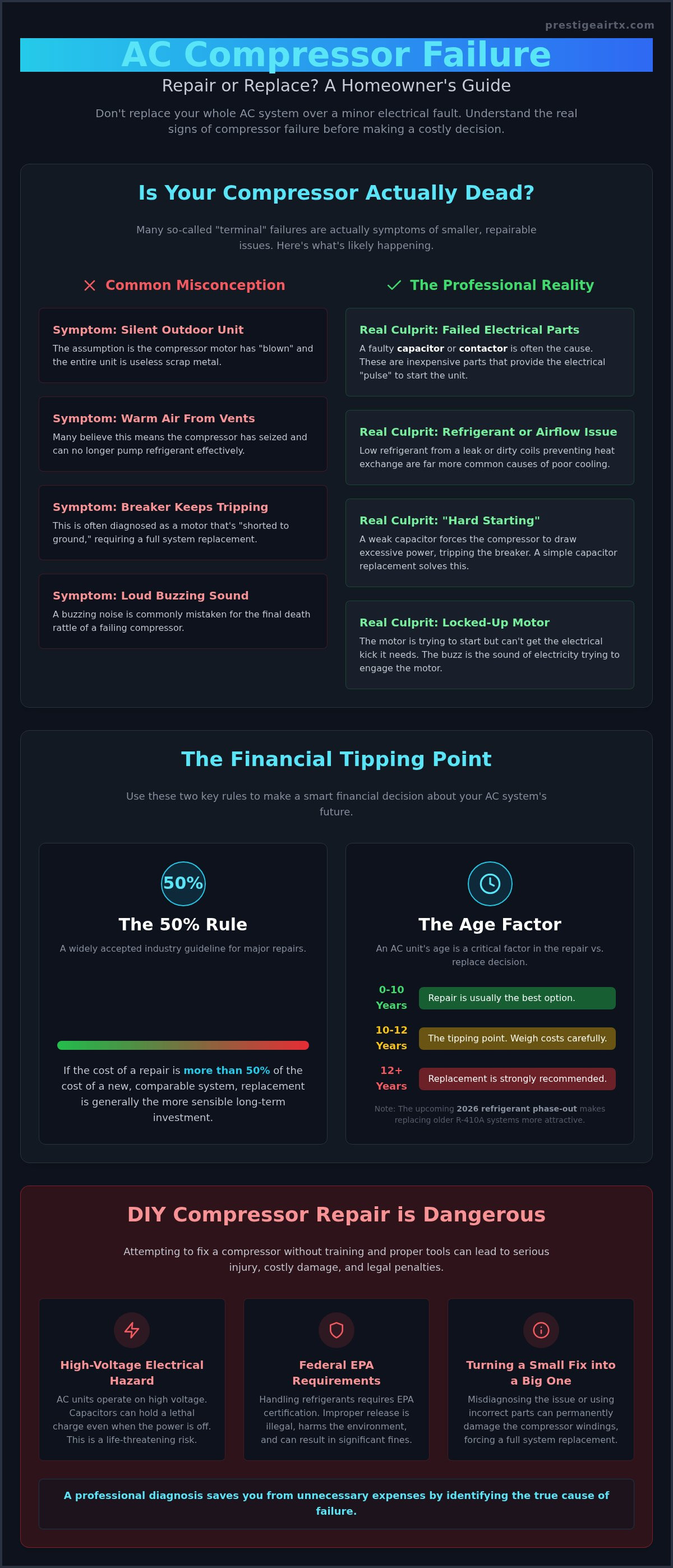
When the temperature climbs in North Richland Hills, a sudden silence from your outdoor unit can trigger immediate financial anxiety. Many homeowners assume that if the fan isn't spinning or the box is quiet, the compressor is "blown" and the entire system is scrap. This is one of the most persistent myths in the HVAC industry. In reality, the compressor is a rugged residential component designed to last 15 years or more; it rarely fails without a secondary cause acting as the catalyst.
Think of the compressor as the heart of your home's cooling system. It's a sealed, hermetic unit that pressurizes refrigerant to move heat from inside your house to the outdoors. Just as a human heart needs a healthy electrical signal to beat, your compressor relies on external components like capacitors and contactors to function. When we perform an AC compressor repair, we often find that the heart is perfectly healthy, but the electrical "pulse" has been interrupted by a failed five dollar part.
The "Warm Air" Misconception
If you feel lukewarm air drifting from your vents, don't assume the motor has seized. While a failing compressor can cause this, it's frequently a symptom of a refrigerant leak or a neglected evaporator coil. The AC compressor is the pump that facilitates heat exchange via refrigerant pressure. If there isn't enough refrigerant to pump, or if the indoor coils are too dirty to absorb heat, the system will struggle to provide comfort regardless of how well the compressor is working. Jumping to a replacement before checking these external factors is a costly mistake that ignores the true mechanical health of your unit.
Why a Tripped Breaker Isn’t Always a Dead Motor
Does your air conditioner trip the circuit breaker every time it tries to start? You might be told the motor is "shorted to ground," which would indeed require a full replacement. However, a weak capacitor often causes "hard starting," where the compressor draws excessive amperage just to get moving. This surge of power trips the breaker as a safety precaution. If you keep resetting the breaker, you risk overheating the windings and turning a simple electrical fix into a permanent mechanical failure. Professional AC compressor repair focuses on identifying these electrical bottlenecks before they cause terminal damage to the motor. We see this often in Keller and Southlake homes where older systems are pushed to their limits during peak summer weeks.
Myth: A buzzing sound means the compressor is dead.
Reality: Buzzing usually indicates a failed contactor or a motor that's trying to start but lacks the electrical "kick" from a capacitor.
Myth: You can't repair a compressor; you have to replace the whole unit.
Reality: While the internal valves are sealed, the external components that keep it running are easily serviceable by a professional.
Understanding the "Heart" of Your Home Cooling System
Unlike the belt-driven compressors found in your vehicle or the massive, open-drive units used in commercial warehouses, your home’s air conditioner utilizes a hermetic compressor. This means the motor and the compression mechanism are sealed together inside a welded steel shell. Because it's a closed system, it's incredibly durable and built to withstand years of service. However, this design also means the internal components rely entirely on the environment provided by the rest of your HVAC system to stay healthy.
In North Texas, our intense summer heat creates significant "head pressure." This is the resistance the compressor meets when trying to discharge heat into the already sweltering outdoor air. If your condenser coils are caked with dust or the outdoor fan is spinning too slowly, that heat has nowhere to go. The compressor must work significantly harder to overcome this resistance, which often leads to a thermal overload. Consistent air conditioner maintenance ensures your coils stay clean, allowing the compressor to shed heat efficiently and avoid the stress of high-pressure operation.
The Refrigerant Cycle and Pressure
The compressor’s primary job is to transform low-pressure gas into a high-pressure, high-temperature liquid. This transition is what makes the heat exchange process possible. However, this mechanical magic relies on precise physics. If refrigerant levels are too low, the compressor will overheat because it actually uses the returning cool gas to keep its own internal motor chilled. Conversely, if levels are too high, you risk "slugging." This occurs when liquid refrigerant, which cannot be compressed, enters the mechanism. Because liquids don't compress, this can snap internal valves or damage the piston instantly.
Electrical Components: The Support Staff
Your compressor doesn't work alone; it relies on a dedicated support staff of electrical components to function safely. The start capacitor provides the massive jolt of torque needed to get the motor spinning from a dead stop, while the run capacitor maintains a steady, efficient electrical flow during the cooling cycle. Meanwhile, the contactor acts as the heavy-duty switch that closes to send power to the unit when your thermostat calls for air. When these parts begin to fail, it might look like you need a major AC compressor repair, but often, replacing a weakened capacitor is all it takes to restore your domestic harmony. Addressing these small electrical issues for a few hundred dollars can prevent the $3,000 price tag of a full mechanical failure later.
The Repair vs. Replace Dilemma: Making a Financial Choice
Deciding whether to invest in an AC compressor repair or opt for a full system replacement is one of the most stressful choices a homeowner faces. To help our neighbors in North Richland Hills make an objective choice, we often suggest the "50% Rule." Simply put, if the cost of the repair exceeds half the value of a new outdoor unit, your money is likely better spent on an upgrade. This is especially true when you consider the long-term reliability of a system that has already suffered a major component failure.
Age is the other critical factor in this equation. In the harsh environment of North Texas, where residential units run almost constantly from May through September, 10 to 12 years is typically the tipping point. Even if the compressor is still under a manufacturer’s parts warranty, you'll still face significant labor and refrigerant costs. If your older system still uses R-22 refrigerant, often called Freon, a repair becomes even harder to justify. With R-22 costs ranging from $400 to $1,200 per pound in 2026, a simple leak repair can quickly spiral into a four-figure bill for a system that's already nearing the end of its life.
Evaluating Efficiency Gains (SEER2)
Don't overlook the hidden costs of keeping an inefficient unit alive. If you're currently repairing an old 10-SEER system, you're missing out on the substantial utility savings provided by modern 16+ SEER2 equipment. A new high-efficiency unit can often pay for its own monthly financing through lower Texas summer electricity bills. Beyond just the numbers, modern compressors offer superior humidity control. For families in Grapevine and Arlington, where summer humidity can make 75 degrees feel like 85, the improved moisture removal of a new system creates a significantly more comfortable domestic environment.
When Repair is the Logical Move
There are many scenarios where a professional AC compressor repair is absolutely the right path. If your system is under eight years old and still covered by a valid manufacturer’s warranty, repairing the unit is usually the most fiscally responsible choice. This is particularly true when the failure is external. If the issue is a failed capacitor, a burnt wire, or a condenser fan motor, these are straightforward fixes that don't require opening the sealed refrigerant system. We also find that minor refrigerant leaks can often be sealed and recharged for a fraction of the cost of a new unit, buying you several more years of reliable service and peace of mind.
Professional Diagnosis: Why DIY Compressor Repair is Risky
While online tutorials make swapping a capacitor look like a five-minute task, they often skip over the life-threatening risks involved. Capacitors in your outdoor unit store a massive electrical charge even after you've flipped the breaker. Touching the wrong terminal can deliver a lethal shock. Beyond physical safety, there are strict legal boundaries. EPA Section 608 regulations mandate that only certified professionals handle and recover refrigerants. Attempting a DIY AC compressor repair that involves opening the refrigerant lines isn't just dangerous; it's a federal violation.
There's also the risk of "acid burnout." When a compressor fails, it often releases acidic contaminants into the oil and lines. If you simply "guess" at parts or swap a motor without a professional system flush, that acid will eat through your new components in weeks. We use specialized toolsets including high-precision multimeters, pressure gauges, and thermal imaging to see what the naked eye cannot. This ensures we aren't just treating a symptom but protecting your entire investment.
What to Expect During a Prestige Air Assessment
During a Prestige Air assessment, we go deeper than a basic "on-off" check. We test the internal windings of the compressor motor to identify subtle insulation breakdowns before they become total shorts. By measuring subcooling and superheat levels, we verify exactly how refrigerant is moving through your system. This precision allows us to find the "root cause." If a fan motor is failing or a thermal expansion valve is sticking, we fix those first so your repaired compressor doesn't fail again a month later.
Local Environmental Factors in Tarrant County
Tarrant County presents unique challenges for HVAC health. In Keller and Southlake, heavy spring pollen and fine Texas dust act like a blanket, suffocating your condenser coils. This lack of airflow forces the compressor to run at dangerously high temperatures. Additionally, our local power grid can experience fluctuations during summer peak hours, which wears down sensitive capacitors and contactors. Regular maintenance is the best insurance you can have against these environmental stressors. If you suspect your system is struggling, schedule a professional diagnostic assessment to get an honest, expert opinion before a small problem becomes a total system failure.
Reliable AC Compressor Solutions in Fort Worth and Keller
When you're facing a potential AC compressor repair, you deserve more than just a technician; you need a trusted neighbor who prioritizes your home's comfort and safety. Prestige Air is a veteran-owned, family-operated business that understands the unique demands of the North Texas climate. We don't just look at the mechanical failure; we look at the domestic harmony of your household. By serving families across North Richland Hills, Colleyville, and Keller, we've built a reputation for integrity and disciplined service that puts the homeowner's needs first.
Transparency is the cornerstone of our consultations. We provide honest "Repair vs. Replace" assessments based on the logical frameworks we've discussed, such as the age of your system and the 50% rule. Our expertise extends beyond the compressor itself. We believe a healthy home requires a holistic approach, which is why we often include an indoor air quality assessment alongside our mechanical evaluations. This ensures that once your system is cooling again, the air your family breathes is as clean and refreshing as it is cold.
The Prestige Air Difference
Our family-operated approach means we treat your home with the same care and precision we would our own. Because we focus exclusively on residential heating and cooling, we aren't distracted by commercial contracts or unrelated plumbing work. This specialization allows us to maintain a high standard of craftsmanship and stay current on the latest residential technologies, including the 2026 transition to A2L refrigerants. When we arrive for an AC compressor repair, we bring a disciplined mentality that ensures every wire is checked and every pressure reading is exact, giving you the peace of mind you deserve.
Taking the Next Step Toward Cool Comfort
Restoring your home's environment starts with a professional assessment. Before your technician arrives, take a moment to note any specific behaviors you've observed. Has the unit been making a new rhythmic clicking sound? Have you noticed a spike in your utility bills despite similar weather? Sharing these details helps us identify root causes faster and more accurately. We're here to provide the reliable, local expertise you need to navigate these decisions without the fear of being upsold on unnecessary equipment.
Don't let a struggling system compromise your family's comfort during the peak of summer. Schedule your professional AC assessment with Prestige Air today and let our experts provide the honest, high-quality service your home requires.
Securing Your Home’s Comfort for the Seasons Ahead
Navigating the technicalities of your HVAC system doesn't have to be overwhelming. You now know that many symptoms pointing toward a total failure are often just signs that external electrical components need attention. By understanding the 50% rule and the impact of the 2026 refrigerant standards, you're equipped to make a logical, financial decision that protects your household budget. Professional AC compressor repair is about more than just fixing a motor; it's about restoring the peace of mind that comes with a reliable, efficient home.
As a veteran-owned and family-operated team, we've been exclusively residential experts serving Keller, NRH, and Southlake since 2020. We take pride in providing the honest, disciplined service our neighbors deserve. Don't let technical jargon or the fear of an upsell keep you in the heat. Get an Honest AC Compressor Diagnosis from Prestige Air. We're here to ensure your environment remains a sanctuary of cool comfort.
Frequently Asked Questions
What are the most common signs of a failing AC compressor?
Common indicators include lukewarm air blowing from your vents, frequent circuit breaker trips, and unusual noises coming from the outdoor unit. You might also notice that the outdoor fan is spinning, but the compressor itself isn't humming. In North Richland Hills, we often find that a unit struggling to start is the first sign of an electrical issue that could lead to a permanent mechanical failure if ignored.
Can an AC compressor be repaired, or must it always be replaced?
While the external electrical components like capacitors and contactors are easily repairable, the internal mechanical parts are sealed within a welded steel shell. If the internal valves or motor windings fail, the compressor itself cannot be serviced and requires replacement. However, many "dead" units we see in Keller only require a professional AC compressor repair to the external wiring or starting components to restore full functionality.
How much does it typically cost to replace a residential AC compressor?
The total investment for a compressor replacement varies based on the unit's tonnage, the specific refrigerant required, and the current warranty status of your equipment. Since the 2026 transition to A2L refrigerants like R-454B, labor and material costs have shifted across the industry. Homeowners should verify if their system is still under the manufacturer's parts warranty, as this can significantly lower the financial burden of the restoration.
Why is my AC compressor making a loud banging or clanging noise?
Loud banging usually indicates a mechanical failure, such as a loose internal component or a broken mounting spring inside the hermetic shell. This is a serious symptom that requires immediate attention. If you hear these sounds at your Arlington or Grapevine home, shut the system down right away. Continuing to run a damaged compressor can cause "slugging" or an electrical short that destroys the entire outdoor unit.
How long should a residential AC compressor last in the Texas heat?
A residential compressor typically lasts between 10 and 15 years in the intense Tarrant County climate. The extreme head pressure caused by 100 degree summer days puts significantly more stress on the motor than in milder regions of the country. Regular maintenance, including cleaning the condenser coils, is the most effective way for homeowners in Southlake and Colleyville to ensure their system reaches its maximum expected lifespan.
Will a bad capacitor destroy my AC compressor?
Yes, a failing capacitor is one of the primary causes of terminal motor failure. When a capacitor loses its ability to store a charge, the compressor struggles to start, which draws excessive amperage and generates intense internal heat. This repeated "hard starting" eventually burns out the motor windings. Addressing a weakened capacitor early is a vital part of AC compressor repair that prevents a much more expensive mechanical breakdown later.
Is it worth replacing the compressor on a 10-year-old AC unit?
Deciding to repair a decade-old system requires looking at the "50% Rule" and the type of refrigerant the unit uses. If your system still relies on R-22, the high cost of the refrigerant often makes a compressor swap financially unwise. For units in Euless or Bedford nearing the ten year mark, we recommend comparing the repair quote against the long term energy savings of a modern, high efficiency SEER2 system.
What is an AC compressor "hard start kit" and do I need one?
A hard start kit is an auxiliary capacitor and relay that provides an extra electrical boost to the motor during the startup cycle. It's often used on older systems in the Fort Worth area to reduce the electrical surge that trips breakers. While these kits can help a struggling motor start more easily, they are often a temporary solution rather than a permanent fix for underlying mechanical or electrical wear.