Why Is My AC Blowing Warm Air? A Homeowner's Troubleshooting Guide
Wondering why is my AC blowing warm air? Our guide helps you troubleshoot common issues like filters & thermostats, and know when to call a pro. Fix it fast!

Imagine walking into your North Richland Hills home after a long day in the Texas sun, only to realize the air coming from your vents feels more like a hairdryer than a refrigerator. That sudden wave of heat is often followed by a surge of anxiety about repair costs and sleepless, humid nights. You aren't alone in wondering, "why is my AC blowing warm air?" as our local systems often run 20% longer than the national average just to keep up with the Fort Worth climate. It's a frustrating situation that can make your home feel less like a sanctuary and more like a source of stress.
We understand that your priority is restoring domestic harmony and safety for your family without overpaying for unnecessary repairs. This guide will help you discover exactly why your air conditioner has stopped cooling so you can regain your peace of mind. You'll learn which fixes you can handle yourself today, such as simple thermostat adjustments or filter changes, and when it's time to call a professional technician. We'll walk through a logical troubleshooting sequence, from checking your outdoor unit for debris to understanding the signs of a refrigerant leak, ensuring you have the knowledge to make the best decision for your home's long-term comfort.
Key Takeaways
Gain clarity on simple thermostat settings, like the "On" versus "Auto" fan mode, which are often the hidden reason why is my AC blowing warm air.
Discover how restricted airflow from a clogged filter can lead to frozen evaporator coils, effectively choking your system's ability to cool your home.
Learn to identify when local environmental factors, like North Texas dust and cottonwood, are preventing your outdoor condenser from releasing heat.
Understand the signs of serious mechanical failures, such as refrigerant leaks or compressor issues, that require the precision of a professional technician.
Explore how a proactive maintenance plan can safeguard your home's comfort and prevent expensive repairs during the peak of the Texas summer.
Table of Contents
Quick Checks: The Most Common Reasons for Warm Air
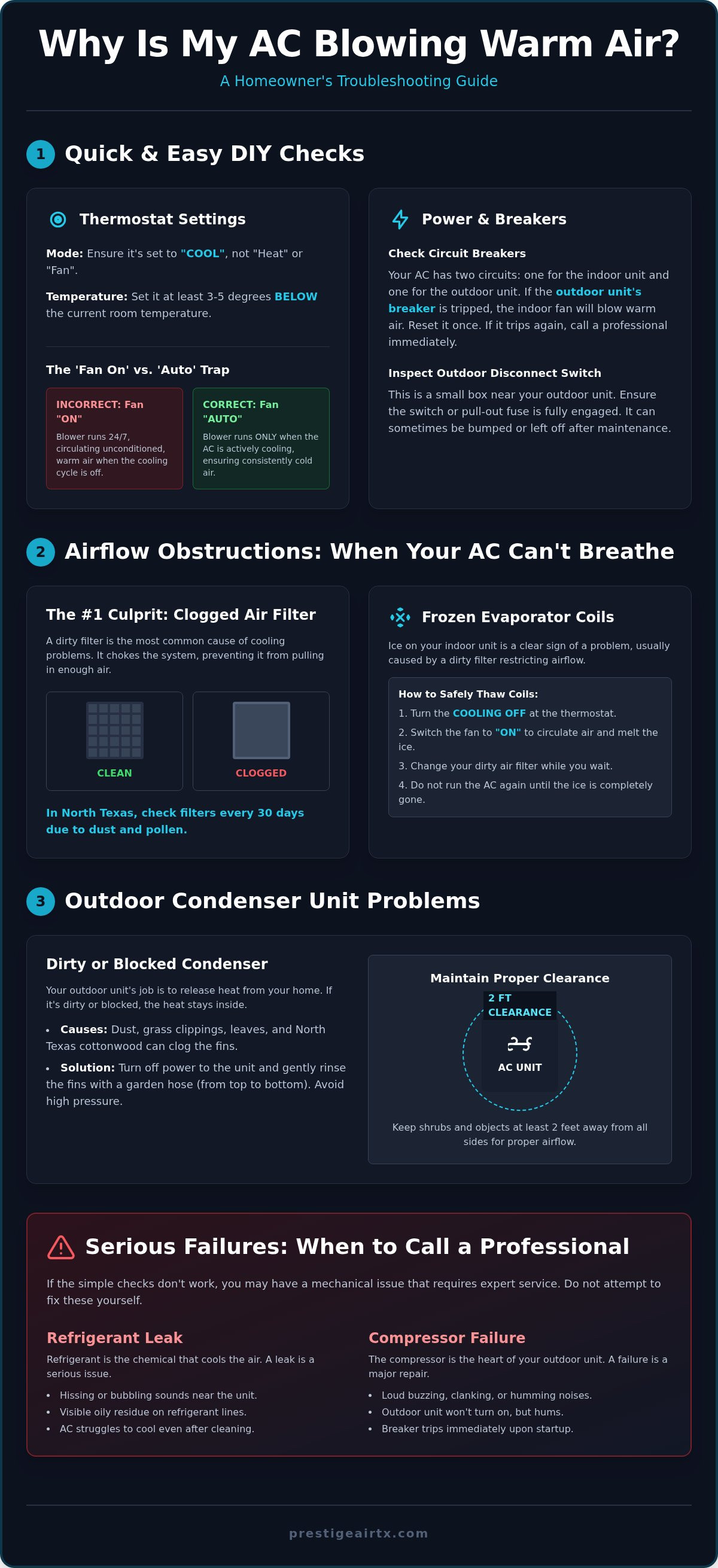
Before you assume your system has reached the end of its life, start with the most accessible components. Many North Richland Hills homeowners find that the answer to why is my AC blowing warm air isn't a mechanical breakdown, but a simple setting that was accidentally changed. Your thermostat acts as the brain of your home's comfort system. If it's set to "Heat" or "Fan" instead of "Cool", the outdoor unit won't receive the signal to start its cooling cycle. Double check that the temperature is set below the current room temperature, and ensure the mode is firmly set to cooling.
The 'Fan On' vs. 'Auto' Trap
The fan switch on your thermostat has two primary settings: "On" and "Auto". When you select "On", the blower motor inside your home runs 24 hours a day, regardless of whether the air is actually being cooled. This circulates unconditioned air through your ducts when the outdoor unit is resting. Because this air isn't being stripped of heat or humidity, it feels noticeably warm coming out of the vents. To restore comfort, switch your thermostat to "Auto". This ensures the fan only runs when the cooling system is actively working. Wait about 10 minutes to see if the air temperature drops.
Power Issues and Tripped Breakers
Your air conditioner is a heavy electrical user that typically requires two separate circuits. One breaker in your main electrical panel controls the indoor air handler, while another larger breaker controls the outdoor condenser. If the outdoor breaker trips, the indoor fan will keep blowing, but it won't be cold because the heat exchange process has stopped. You can safely check your panel for any switches that have moved to the middle or "Off" position. Flip the breaker completely off before switching it back to "On". If it trips again immediately, stop and call a professional, as this indicates a serious electrical fault or a failing component that could pose a safety risk.
Don't forget to inspect the outdoor disconnect switch as well. This is the small metal box located on the exterior wall near your unit. It contains a lever or a pull-out fuse used for maintenance. If this has been bumped or wasn't fully seated after a recent service, your condenser won't receive power, leaving you with nothing but warm air inside despite your thermostat settings.
Airflow Obstructions: When Your AC Can't Breathe
Think of your air conditioner as a giant lung. For it to cool your home, it must constantly pull in warm air, strip away the heat, and push the chilled air back into your living spaces. When this cycle is interrupted by physical blockages, the system struggles to perform its primary job. This simple blockage is often the answer to the question: why is my AC blowing warm air?
The Hidden Danger of a Dirty Air Filter
If you find yourself wondering why is my AC blowing warm air, the first place you should look is your air filter. A clogged filter is the most frequent culprit behind restricted airflow. Over time, the mesh becomes saturated with dust, pet dander, and debris, making it difficult for the blower motor to pull air through. In local areas like Keller and Southlake, our heavy pollen seasons and North Texas dust mean a "three-month" filter might actually need replacement every 30 days to maintain efficiency.
When airflow is restricted, your system may begin short-cycling. Short-cycling occurs when your system turns on and off rapidly because it's struggling to maintain airflow or is overheating. While you might be tempted to buy the highest MERV-rated filter available for better air quality, be cautious. Older residential systems often lack the power to push air through these dense filters, which can inadvertently choke the system and lead to the very cooling issues you're trying to avoid. If your filter looks like a grey wool blanket, it's time for a fresh one.
Identifying and Thawing Frozen Evaporator Coils
If your air conditioner can't pull enough warm air over the indoor evaporator coils, the refrigerant inside stays too cold. Eventually, the moisture in the air freezes onto the coils, creating a literal block of ice that prevents any air from passing through. You might notice your indoor unit "sweating" or dripping water, or you may see visible frost on the copper lines. If you suspect a frozen coil, follow these steps to safely restore your system:
Turn the AC setting to "Off" immediately to stop the cooling cycle.
Switch the fan setting to "On" to circulate room-temperature air over the ice.
Check your condensate drain line to ensure the melting ice doesn't cause a flood.
Never attempt to pick the ice off with a tool or use a hair dryer to speed up the process. Excessive heat can cause thermal shock to the components, and sharp objects can easily puncture the delicate coils. If you've cleared the airflow and the ice returns, it's often a sign of a deeper issue that requires professional air conditioner repair to diagnose correctly.
Also, take a quick walk through your home to ensure furniture, heavy drapes, or rugs aren't blocking your return air vents. These large grilles need clear space to breathe. If you've tucked a sofa right against a return vent, you're forcing your AC to work twice as hard for half the result.
Outdoor Condenser Problems in the Texas Heat
While the indoor unit absorbs heat from your living spaces, the outdoor condenser is responsible for dumping that heat into the environment. This exchange is a critical part of the cooling cycle. If the outdoor unit cannot breathe, the heat remains trapped inside your system. This often explains why is my AC blowing warm air even when your indoor air filter is perfectly clean. In the intense North Texas summer, your condenser is under immense pressure to perform, and even minor obstructions can lead to a total loss of cooling.
Our local environment presents unique challenges for these outdoor units. During late spring and early summer, cottonwood trees release fluffy seeds that act like a vacuum-sealed blanket around your condenser coils. When this fluff combines with our famous North Texas "red dirt" or clay dust, it creates a thick, insulating layer. This layer prevents the refrigerant from releasing its heat, forcing the compressor to work harder until it eventually overheats and shuts down.
Cleaning Your Condenser Coils Safely
A clogged coil is easy to spot if you know what to look for. A healthy coil should show the clean, metallic glint of aluminum fins. If your unit looks grey, fuzzy, or caked in brown silt, it needs attention. You can often restore your system's efficiency by gently rinsing the unit with a standard garden hose. Use low pressure and move the stream from top to bottom to wash away the silt and cottonwood debris. Never use a pressure washer for this task. The high-pressure water can easily bend the delicate aluminum fins, permanently restricting airflow and leading to a much more expensive repair bill.
Clearing the Area Around Your Unit
For your condenser to function correctly, it needs a steady supply of fresh air. We follow the "2-foot rule," which means maintaining at least 24 inches of clear space on all sides of the unit. In Haltom City and Richland Hills, where landscaping can grow rapidly, it's easy for shrubs, tall grass, or stored outdoor equipment to crowd the HVAC pad. When a unit is crowded, it pulls in the same hot air it just exhausted. This "re-circulation" prevents the system from cooling properly and can cause why is my AC blowing warm air to become a recurring headache. Keep your bushes trimmed and ensure no firewood or storage bins are leaning against the unit to protect your home's peace of mind.
Finally, take a moment to look at the fan on top of the condenser. It should be spinning rapidly and pushing a strong current of hot air upward. If the fan is moving slowly or you see debris like sticks or large leaves jammed in the blades, the motor may be struggling. Safely clearing away external debris can sometimes get things moving again, but if the fan remains stationary while the unit hums, it's a sign that the motor or capacitor has failed.
Mechanical and Chemical Failures: When to Call Prestige Air
If you have checked your thermostat, replaced your filter, and cleared your outdoor unit, but still find yourself asking why is my AC blowing warm air, the issue likely involves a mechanical or chemical failure. These problems occur within the internal components of your system and require specialized tools and technical precision to resolve. When the fundamental cooling cycle is broken at a chemical or mechanical level, DIY troubleshooting reaches its limit, and the safety of your home's electrical system becomes the priority.
Refrigerant Leaks and the 'Sealed System' Myth
There's a common misconception that air conditioners occasionally need to be "topped off" with refrigerant. In reality, your HVAC is a sealed system. Refrigerant is the chemical lifeblood that carries heat out of your home; it isn't a fuel that gets used up over time. If your levels are low, you have a physical leak that needs attention.
A refrigerant leak is essentially a hole in your copper lines or evaporator coils. Simply adding more refrigerant without fixing the source is like trying to fill a bucket with a hole in the bottom. It's an expensive cycle that harms the environment and forces your system to run at reduced efficiency. You might even hear a faint hissing or bubbling sound near the unit, which is a clear sign of escaping gas. Our technicians use advanced leak detection technology to find the exact root cause, ensuring a permanent restoration of your home's comfort rather than a temporary patch.
Capacitors and Fan Motors
If the compressor is the heart of your AC, the capacitor is the "spark plug" that gets it started. In Grapevine and the surrounding areas, the extreme summer heat is the primary enemy of these electrical components. Capacitors store a high-voltage charge to kick the compressor and fan motors into gear when the thermostat calls for cooling.
When temperatures soar, these parts can swell and "pop" like a soda can left in a hot car. If your capacitor fails, you might hear a clicking or humming sound from your outdoor unit, but the fan and compressor won't actually turn on. This results in your indoor vents pushing uncooled air throughout the house. Because these components involve high-voltage electricity and can hold a charge even when the power is off, this is a repair that requires a certified professional. Handling these parts without the proper training poses a significant safety risk to homeowners.
If your system is humming but failing to drop the temperature, don't let the compressor overheat. It's best to turn the system off and schedule a professional air conditioner repair to diagnose the failure before it leads to a more costly compressor replacement.
The most effective way to stop askingwhy is my AC blowing warm airis to catch a potential failure before the first Texas heatwave hits. In our region, air conditioners run approximately 20% longer than the national average, which places an immense burden on every mechanical part. This extra strain makes a spring tune-up a smart financial decision rather than just a luxury. By identifying a weak capacitor or a minor refrigerant leak in April, you avoid the anxiety of an emergency breakdown during a 100-degree July afternoon. Consistent maintenance doesn't just restore cooling; it safeguards the long-term health of your residential system and helps you avoid the "Texas tax" of premature equipment replacement.
What’s Included in a Professional Tune-Up?
A professional maintenance visit involves a methodical inspection designed to ensure every component operates at peak efficiency. Our technicians measure amperage draws on your blower and condenser motors to confirm they aren't pulling excessive power, which can lead to overheating. We verify refrigerant pressures and tighten all electrical connections to prevent the vibrations of a long cooling season from loosening your system's wiring. We also prioritize the safety of your home by clearing the condensate drain line to prevent clogs and potential water damage. Every visit includes an indoor air quality assessment, ensuring the air your family breathes is as clean as it is cool.
The Prestige Air Difference for Local Homeowners
Prestige Air applies veteran-owned discipline and high-integrity standards to every residential HVAC system we touch. We are a family-operated team that truly values the domestic harmony of our neighbors. Serving the community from Hurst to Southlake since 2020, we focus exclusively on residential needs, ensuring you receive specialized expertise without commercial distractions. We take pride in being the protective expert you can trust to deliver honest advice and thorough craftsmanship. You shouldn't have to worry about the reliability of your home's environment when the summer heat arrives. Schedule your professional AC assessment with Prestige Air today and let us help you maintain a comfortable, safe home all year long.
Restore Your Home's Comfort and Harmony
Understanding why is my AC blowing warm air is the first step toward reclaiming your sanctuary from the Texas heat. Whether the solution is as simple as flipping a thermostat switch or as complex as repairing a hidden refrigerant leak, you now have the knowledge to diagnose the issue with confidence. Your air conditioner is a hardworking machine that thrives on regular care; especially in our demanding local climate where systems run harder and longer than the national average.
If your troubleshooting has reached its limit, don't risk your system's long-term health with further guesswork. Your comfort matters. Our team at Prestige Air consists of dedicated residential HVAC specialists who bring veteran-owned discipline to every repair in Tarrant County. We are a family-operated business that prioritizes your safety and domestic harmony above all else. Schedule Your Professional AC Repair in Fort Worth today to ensure your environment is in capable, caring hands. We are ready to restore your system's efficiency and help you enjoy a cool, worry-free summer.
Frequently Asked Questions
Why is my AC running but not blowing cold air?
If your system is running but the air isn't cold, check your thermostat and the outdoor unit's breaker. Often, the indoor fan continues to blow even if the outdoor compressor has lost power or failed. This disconnect in the cooling cycle is a frequent reason why is my AC blowing warm air. Identifying if the outdoor unit is actually humming or spinning is the first step in troubleshooting the problem.
Can a dirty air filter really cause my AC to blow warm air?
Absolutely. A clogged filter chokes the system, preventing warm air from reaching the evaporator coils. Without enough heat to absorb, the coils drop below freezing and turn moisture into ice. This ice block prevents any air from being cooled as it passes through. For homeowners in dusty areas like Keller or Watauga, changing filters every 30 days during the peak of summer is a simple way to maintain domestic harmony.
How do I know if my AC is low on refrigerant?
You might notice ice forming on the copper refrigerant lines or hear a faint hissing sound near the unit. Since your air conditioner is a sealed system, it should never "run out" of refrigerant. Low levels indicate a leak that must be found and repaired. This chemical failure is a serious reason why is my AC blowing warm air and requires a technician with specialized leak detection tools to fix.
Why is my outdoor AC unit fan not spinning?
A non-spinning fan is often the result of a failed capacitor or a seized motor. In the extreme heat of Grapevine and Colleyville, capacitors can swell and fail, leaving the fan without the electrical "kick" it needs to start. If you hear a humming sound but see no movement, turn the power off immediately. Continuing to run the system without the fan will quickly cause the compressor to overheat and fail.
Is it safe to run my AC if it's blowing warm air?
It isn't safe for the health of your HVAC system to keep it running when it's blowing warm air. Doing so forces the compressor to work under extreme stress without the cooling effect of the refrigerant cycle. This can lead to a total mechanical breakdown or expensive electrical damage. If your North Richland Hills home isn't cooling, turn the system off at the thermostat to protect your investment until a professional can arrive.
How much does it cost to fix an AC blowing warm air in Fort Worth?
The cost depends entirely on the root cause of the failure. Minor fixes like replacing a capacitor or a dirty filter are relatively inexpensive, while repairing a refrigerant leak or replacing a motor involves more labor and parts. Because every residential system in Fort Worth is unique, we recommend a professional diagnostic visit. This ensures you get an accurate estimate based on the specific needs of your home rather than a vague industry average.
What should I do if my AC coils are frozen?
Start by turning the AC off and switching the thermostat fan setting to "On." This circulates unconditioned air to melt the ice safely. While you wait, replace your air filter and ensure all vents in your Haltom City home are open and clear of furniture. Never attempt to scrape ice off the coils with a tool, as the copper and aluminum components are very delicate and easy to puncture.
How often should I have my AC serviced in Texas?
We recommend a professional tune-up twice a year: once in the spring for your AC and once in the fall for your heating system. Air conditioners in the Fort Worth area run significantly more than in other parts of the country. Regular maintenance helps you avoid the "Texas tax" of premature system failure. Routine checks ensure your system operates with the precision and efficiency needed to keep your family comfortable all summer long.